Use of cookies

We use cookies to improve and analyse your browsing experience on our web. You can accept these cookies, reject them or choose your settings by clicking on the corresponding buttons. Please note that rejecting cookies may affect your browsing experience. For more information you can consult our Cookies policy.

Configure cookies

Cookies are an essential part of how our web works. The main goal of cookies is to make your browsing experience more comfortable and efficient and to improve our services and the web itself.
Here you can find all the information about the cookies we use and you can activate and/or deactivate them according to your preferences, except for those cookies that are strictly necessary for the operation of the web. Blocking some cookies may affect your experience on the web and how the site works. For more information you can visit our Cookie Policy.

Strictly necessary (technical) cookies

These Cookies are necessary for the web to function and cannot be disabled on our systems. They are generally only set up in response to actions you may take such as requesting services, setting your privacy preferences, logging in or completing forms. You can set your browser to block or warn you about these cookies, but some parts of the web will not work. Information about Cookies.

Analytical cookies

These Cookies allow us to count the number of visits and traffic sources so that we can measure and improve the performance of our site. They help us to find out which pages are the most popular and least popular, and to see how visitors move around the web. All information collected by these Cookies is aggregated and therefore anonymous. If you do not allow these Cookies we will not know when you visited our web. Information about Cookies.

Third party cookies

These cookies are used to analyse your activity in order to show you personalised advertisements. Information about Cookies.

Accept Decline Configure cookies Confirm selected
Search
×
Notes
Search
There are no notes
  • Conversion of units and scientific notation
  • To customise Pencil press Alt + Down Arrow
  • To customise Highlighter press Alt + Down Arrow

    Change theme

    Error - please check your internet connection...
    Back

    Blink Help

    x
    Error - please check your internet connection...

    How can we help you?

    No results

    View full manual

    Couldn't find what you were looking for?

    Please describe the issue you are experiencing and provide as many details as possible. Let us know the book, class, access device, licence code, username, used browser or if it occcurs in our app:

    Thickness:
    Font size:
    Filter
      No resources found
      Font size:
      Revision mode

      Revision mode

      Conversion of units and scientific notation
      Science and measurement
      Without background sound
      Logo


      Conversion of units and scientific notation
      Science and measurement
      Without background sound
      Logo

      Unit converter


      Conversion of units and scientific notation
      Science and measurement
      Without background sound
      Logo

      Scientific notation

      Sometimes, the result of an operation on a calculator is a very large or very small number, and it is not always viable to use multiples or submultiples to express it.

      Scientific notation is a way of writing numbers that makes them easier to read and understand.
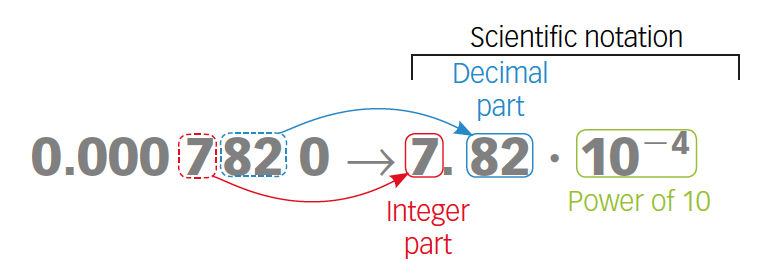
      Scientific notation is a way of writing large numbers using
      integers, decimals and powers of ten.

      Conversion of units and scientific notation
      Science and measurement
      Without background sound
      Logo


      Conversion of units and scientific notation
      Science and measurement
      Without background sound
      Logo

      How far is Orion?

      The Orion nebula is 1,270 light years away. To express this in other units
      it is best to use scientific notation:

      1.2 · 1016 km

      Conversion of units and scientific notation
      Science and measurement
      Without background sound
      Logo

      Let's see an example

      Write the following numbers using scientific notation:

      a) 346,000

      b) 0.000064

      We are going to draw a table with a column for each number:

        a b

      1. Look at the original number.

      346,000

      0.000064

      2. Write the first digit other than zero, then a decimal point followed by the remaining digits. Don’t write the zeros to the right of the decimal point. 3.46 6.4
      3. Write the power of ten (10x). Count how many places you have to move the decimal point until you only have one integer left. This is the exponent that you will use.

      3 4 con paréntesis de arriba encima pila 6 coma con paréntesis de arriba encima 0 con paréntesis de arriba encima 0 con paréntesis de arriba encima 0 con paréntesis de arriba encima flecha derecha negrita 3 negrita. negrita 46 negrita por negrita 10 elevado a negrita 5

      If the number was bigger than one, the power will be positive.

      0.0 con paréntesis de arriba encima 0 con paréntesis de arriba encima 0 con paréntesis de arriba encima 6 con paréntesis de arriba encima 4 flecha derecha negrita 6 negrita. negrita 4 negrita por negrita 10 elevado a negrita menos negrita 5 fin elevado

      If the number was smaller than one, the power will be negative.


      Conversion of units and scientific notation
      Science and measurement
      Without background sound
      Logo

      Activities

      Conversion of units and scientific notation
      Science and measurement
      Without background sound
      Logo

      Converting units

      Convert these amounts and fill the blanks.

      0.0062 g → mg

      167 g → kg

      0.05 m2→ cm2

      30 mL → L

      0.3 L → cm3

        0.167 300 0.03 6.2 500

      Done
      Conversion of units and scientific notation
      Science and measurement
      Without background sound
      Logo

      Time units

      Match each time unit to its corresponding equivalent.

      • 15 min

      • 1 h 30 min

      • 1 day

      • 1 year

      • 1 month (30 days)

      • 3,600 s

      • 1 week

      • 86,400 s

      • 1 h

      • 90 min

      • 31,536,000 s

      • 720 h

      • 10,080 min

      • 0.25 h

      Done
      Conversion of units and scientific notation
      Science and measurement
      Without background sound
      Logo

      Scientific notation

      Write, with all its digits, the following numbers written in scientific notation.

      Help: Write numbers without blanks and remember to use a dot (decimal point) for decimals.

      2.705 · 102→

      1.075 · 10–4→

      3.05 · 106→

      4.06 · 10–6→

      3.99 · 109→

      7.0002 · 10–5→

        0.00000406 270.5 0.000070002 3,990,000,000 305,000 0.0001075

      Done
      Conversion of units and scientific notation
      Science and measurement
      Without background sound
      Logo

      Kick the ball!

      A football player kicks the ball for a penalty kick. The ball reaches a speed of 34 m/s. What's the speed in km/h?

      (0 words)

      Done
      Conversion of units and scientific notation
      Science and measurement
      Without background sound
      Logo

      Density units

      The air in a room has a density of 1,225, expressed in SI units.

      Now, express the density in g/L.

      (0 words)

      Done
      Conversion of units and scientific notation
      Science and measurement
      Without background sound
      Logo

      Speed of light

      Light travels at 300,000 km/s. Calculate its speed in m/h and express the result in scientific notation.

      (0 words)

      Done
      Conversion of units and scientific notation
      Science and measurement
      Without background sound
      Logo

      At a snail's speed

      A garden snail moves at 14 mm/s. Calculate its speed in km/h and express it in scientific notation.

      (0 words)

      Done
      Conversion of units and scientific notation
      Science and measurement
      Without background sound
      Logo

      Now I know


      Conversion factors
      subtitulo

      A conversion factor is a fraction that has the same amount in its numerator and denominator, expressed in different units.


      How to find the appropriate conversion factor
      subtitulo

      1. We write the quantity of the unit we want to change.

      2. Next to it, we write a fraction with the unit we want to convert and the unit we want to convert it to. We do it so that the starting unit is simplified.

      3. We write the equivalent of the other unit next to each one.

      4. We finish by simplifying what is left over and express the final result.


      Scientific notation
      subtitulo

      Scientific notation is a way of writing large numbers using integers, decimals and powers of ten.

      For example: 0.0000013 = 1.3 · 106


      ,
      You have completed the lesson!

      Below is the time you have spent on the activity and the score you obtained.

      Time spent

      Score

      1. 1
      2. 2
      3. 3
      4. 4
      5. 5
      6. 6
      7. 7
      8. 8
      9. 9
      10. 10
      11. 11
      12. 12
      13. 13
      14. 14
      15. 15
        Eraser
        Rich text editor
        close