tester

Use of cookies

We use cookies to improve and analyse your browsing experience on our web. You can accept these cookies, reject them or choose your settings by clicking on the corresponding buttons. Please note that rejecting cookies may affect your browsing experience. For more information you can consult our Cookies policy.

Configure cookies

Cookies are an essential part of how our web works. The main goal of cookies is to make your browsing experience more comfortable and efficient and to improve our services and the web itself.
Here you can find all the information about the cookies we use and you can activate and/or deactivate them according to your preferences, except for those cookies that are strictly necessary for the operation of the web. Blocking some cookies may affect your experience on the web and how the site works. For more information you can visit our Cookie Policy.

Strictly necessary (technical) cookies

These Cookies are necessary for the web to function and cannot be disabled on our systems. They are generally only set up in response to actions you may take such as requesting services, setting your privacy preferences, logging in or completing forms. You can set your browser to block or warn you about these cookies, but some parts of the web will not work. Information about Cookies.

Analytical cookies

These Cookies allow us to count the number of visits and traffic sources so that we can measure and improve the performance of our site. They help us to find out which pages are the most popular and least popular, and to see how visitors move around the web. All information collected by these Cookies is aggregated and therefore anonymous. If you do not allow these Cookies we will not know when you visited our web. Information about Cookies.

Third party cookies

These cookies are used to analyse your activity in order to show you personalised advertisements. Information about Cookies.

Accept Decline Configure cookies Confirm selected
Search
×
Notes
Search
There are no notes
  • 1. Grammar: Modals
  • To customise Pencil press Alt + Down Arrow
  • To customise Highlighter press Alt + Down Arrow

    Change theme

    Error - please check your internet connection...
    Back

    Blink Help

    x
    Error - please check your internet connection...

    How can we help you?

    No results

    View full manual

    Couldn't find what you were looking for?

    Please describe the issue you are experiencing and provide as many details as possible. Let us know the book, class, access device, licence code, username, used browser or if it occcurs in our app:

    Thickness:
    Font size:
    Filter
      No resources found
      Font size:
      Revision mode

      Revision mode

      1. Grammar: Modals
      5th project: Lights, camera… action!
      Without background sound

      MODAL VERBS

      Modal verbs indicate possibility, obligation, ability or give permission.

      Modal verbs go before other verbs.

      The most common modal verbs are:

      CAN - COULD - WOULD - WILL - SHALL - MUST - SHOULD - MIGHT - WILL - MAY - OUGHT TO
       

      1. Grammar: Modals
      5th project: Lights, camera… action!
      Without background sound

      Can/ Can't

      The modal can (negative: can't) expresses the ABILITY to do something.

      It can expresses POSSIBILITY/IMPOSSIBILITY, PERMISSION too.

      Can and can't have the same form in all persons.

      We don't use the forms do and does with modals.

      Can is followed by the infinitive without to.

      • She can play the piano really well.
      • He can't cook very well.
      • They can speak French but they can't speak Japanese.
      • A - Can you swim?
      • B - Yes I can/ No I can't
      • A - She is very far from here! Can she hear me?
      • B - Yes, she can/ No, she can't


      1. Look at the table and FILL IN can or can’t

        BETTY JASON LINDA
      COOK ✓ X X
      DRAW ✓ X ✓
      SING X X ✓
      SPEAK ENGLISH X ✓ ✓
      PLAY THE GUITAR ✓ ✓ X
      RIDE A BIKE ✓ ✓ ✓
      • Linda cook but she draw.
      • Jason speak English and he play the guitar but he cook.
      • Betty sing but she draw.
      • Betty, Jason and Linda ride a bike.
      • Betty and Jason sing but they play the guitar.
         
        can't can

      Done
      1. Grammar: Modals
      5th project: Lights, camera… action!
      Without background sound


      1. Look at the table again. In pairs, ask and answer questions, as in the example.

      A: Can Betty cook?

      B: Yes, she can.

      A: Can Jason cook?

      B: No, he can’t.

      Done
      1. Grammar: Modals
      5th project: Lights, camera… action!
      Without background sound

      Could/ Couldn't

      Could (negative: couldn't) is the past of can, and has the same form in all persons.

      Could is followed by the infinitive without to.

      1. Exercise:

      1) Write three things you could do when you were two.  
      Ex. I could run.

      2) Write three things you can do now that you couldn't do when you were two.  
      Ex. I couldn't write when I was two, but I can write now.

      3) Write two things you couldn't do when you were two and you still can't do.  
      Ex. I couldn't sing when I was two and I still can't sing.
       

      (0 words)

      Done
      1. Grammar: Modals
      5th project: Lights, camera… action!
      Without background sound

      Must - Mustn't

      The modal verb must (negative: mustn't) is used when you think it is necessary to do something. 

      Must expresses strong obligation.

      Must / Mustn't have the same form in all persons.

      Must is followed by the infinitive without to.

      • It's a fantastic film. You must see it.
      • The windows are very dirty. I must clean them.
      • I mustn't forget to phone Tom.
      1. What MUST or MUSTN’T you do in class?
        Use the verbs/ phrases and make sentences.

      BE POLITE TO YOUR TEACHER

      TALK

      EAT AND DRINK

      BE LATE

      LISTEN TO YOUR TEACHER

      BE QUIET  


      (0 words)

      Done
      1. Grammar: Modals
      5th project: Lights, camera… action!
      Without background sound

      May - Might

      'May' is a modal verb

      It does not take an  's' in the present tense.

      The past tense is 'might'.
       

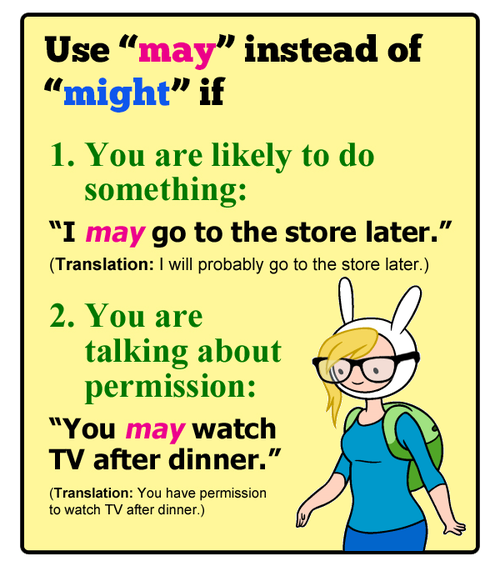
      The modal verbs may and might are used to express a POSSIBILITY.

      May/Might has the same form in all persons.

      May/Might is followed by the infinitive without to.

      • It may rain tomorrow.
      • You may use my car.
      • She may be right.
      • We might go to the disco Saturday night.
      • Take the umbrella with you. It might rain.
      • I might not go to work tomorrow.

      Las formas mayn't y mightn't son muy inusuales, sólo se utilizan en las question tags.

      'May' is also used to express:

      Permission:

      May I go out Mum?

      You may eat some cake Jim.

      Probability:

      He may come late.

      He may be on holidays.

      Suggestion or reproach with 'might':

      He doesn't know what to do; he might ask Wendy.

      You might have done the washing-up !

      Wish :

      May this year bring you happiness and health !

      He might have been eliminated!

      He may have phoned while I was having a shower.

      1. Choose the correct option.

      • Take your umbrella as it  today. 
      • He is still at work ! He late I am afraid.
      • John couldn't repair his washing-machine; he his neighbour. 
      • They talked too loudly. They  the baby !
      • Darling! I wonder if I  you that marvellous car you saw yesterday ?
      • Mum ! My friends are having a party tonight ;   please? 
      • Sweetheart ! As you were at home, you  the ironing, don't you think ?
      • Yes darling, but I was afraid I your marvellous shirt !
      • He  late because his flight has been delayed. 
      • Look at those clouds ! It in a minute. 

      Done

      ,
      You have completed the lesson!

      Below is the time you have spent on the activity and the score you obtained.

      Time spent

      Score

      1. 1
      2. 2
      3. 3
      4. 4
      5. 5
        Eraser
        Rich text editor
        close