Use of cookies

We use cookies to improve and analyse your browsing experience on our web. You can accept these cookies, reject them or choose your settings by clicking on the corresponding buttons. Please note that rejecting cookies may affect your browsing experience. For more information you can consult our Cookies policy.

Configure cookies

Cookies are an essential part of how our web works. The main goal of cookies is to make your browsing experience more comfortable and efficient and to improve our services and the web itself.
Here you can find all the information about the cookies we use and you can activate and/or deactivate them according to your preferences, except for those cookies that are strictly necessary for the operation of the web. Blocking some cookies may affect your experience on the web and how the site works. For more information you can visit our Cookie Policy.

Strictly necessary (technical) cookies

These Cookies are necessary for the web to function and cannot be disabled on our systems. They are generally only set up in response to actions you may take such as requesting services, setting your privacy preferences, logging in or completing forms. You can set your browser to block or warn you about these cookies, but some parts of the web will not work. Information about Cookies.

Analytical cookies

These Cookies allow us to count the number of visits and traffic sources so that we can measure and improve the performance of our site. They help us to find out which pages are the most popular and least popular, and to see how visitors move around the web. All information collected by these Cookies is aggregated and therefore anonymous. If you do not allow these Cookies we will not know when you visited our web. Information about Cookies.

Third party cookies

These cookies are used to analyse your activity in order to show you personalised advertisements. Information about Cookies.

Accept all Decline Configure cookies Confirm selected
Search
×
Notes
Search
There are no notes
  • The modern atomic model
  • To customise Pencil press Alt + Down Arrow
  • To customise Highlighter press Alt + Down Arrow

    Change theme

    Error - please check your internet connection...
    Back

    Blink Help

    x
    Error - please check your internet connection...

    How can we help you?

    No results

    View full manual

    Couldn't find what you were looking for?

    Please describe the issue you are experiencing and provide as many details as possible. Let us know the book, class, access device, licence code, username, used browser or if it occcurs in our app:

    Thickness:
    Font size:
    Filter
      No resources found
      Font size:
      Revision mode

      Revision mode

      The modern atomic model
      Atoms and the periodic table
      Without background sound

      The modern atomic model

      I will know

      • The modern atomic model.
      • What are the atomic orbitals.
      • Where the orbitals are located.
      • What is the energy in the different orbitals.

      Multilingual
      competence

      Multilingual competence

      Multilingual competence is the ability to use different languages appropriately and effectively for communication.

      It includes historical aspects and value and respect for linguistic and cultural diversity to build democratic coexistence.

      Think and discuss

      Do you know of any other experiments that Schrödinger is famous for? They are not all physical experiments, they can be mental ones, too. 

      After studying the spectrum of many different atoms, it was found that there were more spectral lines than Bohr's atomic model could explain.

      The existence of more spectral lines meant that electrons of the atom could be found in many different energy states.

      By applying the principles of quantum mechanics, Austrian scientist Erwin Schrödinger (1887‑1961) concluded that each energy layer or level of an atom's shell had several sub-levels. Schrödinger also established how many levels there were in each layer and how the electrons were distributed in each one of them.

      What's in the image?

      The spectrum is the "ID" of an element. The lines in the absorption spectrum correspond with the lines in the emission spectrum. For each element, the emission and the absorption spectrums are complementary. 
      The modern atomic model
      Atoms and the periodic table
      Without background sound

      Atomic orbitals

      Orbitals can have different shapes and sizes. Let’s have a look.


      An orbital is an area where there is a high probability  (greater than 90%) of finding an electron.


      The modern atomic model
      Atoms and the periodic table
      Without background sound

      The location of the orbitals

      Schrödinger's investigations led to the discovery of the orbitals in each layer of the atom's shell:

      • Layer 1: one s orbital.

      • Layer 2: s and p orbitals.

      • Layer 3: s, p and d orbitals.

      • Layer 4 and following layers: s, p, d and f orbitals.

      To designate an orbital, the layer number and the letter indicating the type are used, for example, 2s, 5p, etc. Orbitals of the same type have the same shape, although their size gets bigger as the number of the layer increases. Therefore, orbitals 2s and 3s are both spherical, but 3s is larger.

      Comparison of the orbit of an electron according to Bohr's  atomic model and according to the quantum mechanical model.

      The outer limit of the orbit is the area where electrons are  most likely to be found. But electrons are also found in other positions.


      The modern atomic model
      Atoms and the periodic table
      Without background sound

      Orbital energy

      In general, an orbital's energy depends on its layer. There are sometimes variations due to the interactions between electrons. However, it is possible to order the orbitals according to their energy.

      All orbitals of the same type in the same layer have the same energy, unless the atom is in a magnetic field. Each layer represents an energy level, and each type of orbital is a sub-level.

      This is the order of energy in the orbitals in the first four levels. The black arrows represent the electrons that can be found in each orbital.

      The modern atomic model
      Atoms and the periodic table
      Without background sound

      Moeller diagram

      The Moeller diagram is a mnemonic tool that indicates the order of the orbitals according to their energy. We can see how to use it in the following box.

      The rule of diagonals, or Moeller's diagram, helps us to remember the order that we need to follow.

      The diagram shows the different types of orbitals. In other words, when we write 2p, this refers to the three 2p orbitals; when we write 3d, this refers to the five 3d orbitals; and when we write 4f, this refers to the seven 4f orbitals.


      The modern atomic model
      Atoms and the periodic table
      Without background sound

      Activities

      The modern atomic model
      Atoms and the periodic table
      Without background sound

      Atomic orbitals

      The quantum mechanical model showed that the shell of an atom was organised in layers and that each layer could  contain different types of orbitals: s, p, d and f.

      Indicate which types of orbital are found in each of the first five layers of an atom’s shell.

      1. First layer.
      2. Second layer.
      3. Third layer.
      4. Fourth layer.
      5. Fifth layer.

      Done
      The modern atomic model
      Atoms and the periodic table
      Without background sound

      Orbital energy

      Have a look at the Moeller diagram.

      Place the following types of orbital in order of increasing energy.

      Done
      The modern atomic model
      Atoms and the periodic table
      Without background sound

      Number of orbitals in the same layer

      There is only one of some types of orbital in each layer, but there can be more than one of other types.

      Complete the table by stating how many of each type of orbital can be found in the same layer of the atom’s shell.

      Type of orbital S P d f
      Nº. of orbitals in the same layer


      Done
      The modern atomic model
      Atoms and the periodic table
      Without background sound

      Now I know

       
      The modern atomic model
      subtitulo

      Erwin Schrödinger (1887‑1961) concluded that each energy layer or level of an atom's shell had several sub-levels. Schrödinger also established how many levels there were in each layer and how the electrons were distributed in each one of them.

       
      Atomic orbitals
      subtitulo

      An orbital is an area where there is a high probability  (greater than 90 %) of finding an electron.

      Orbitals could have different shapes and sizes depending on the layer of the shell. Each layer may have various orbitals with the same (or a very similar) shape and a different orientation. These are orbitals of the same type.

      Each type of orbital is designated with a letter (s, p, d, f), and if there are several, a subscript indicating its spatial orientation is added.
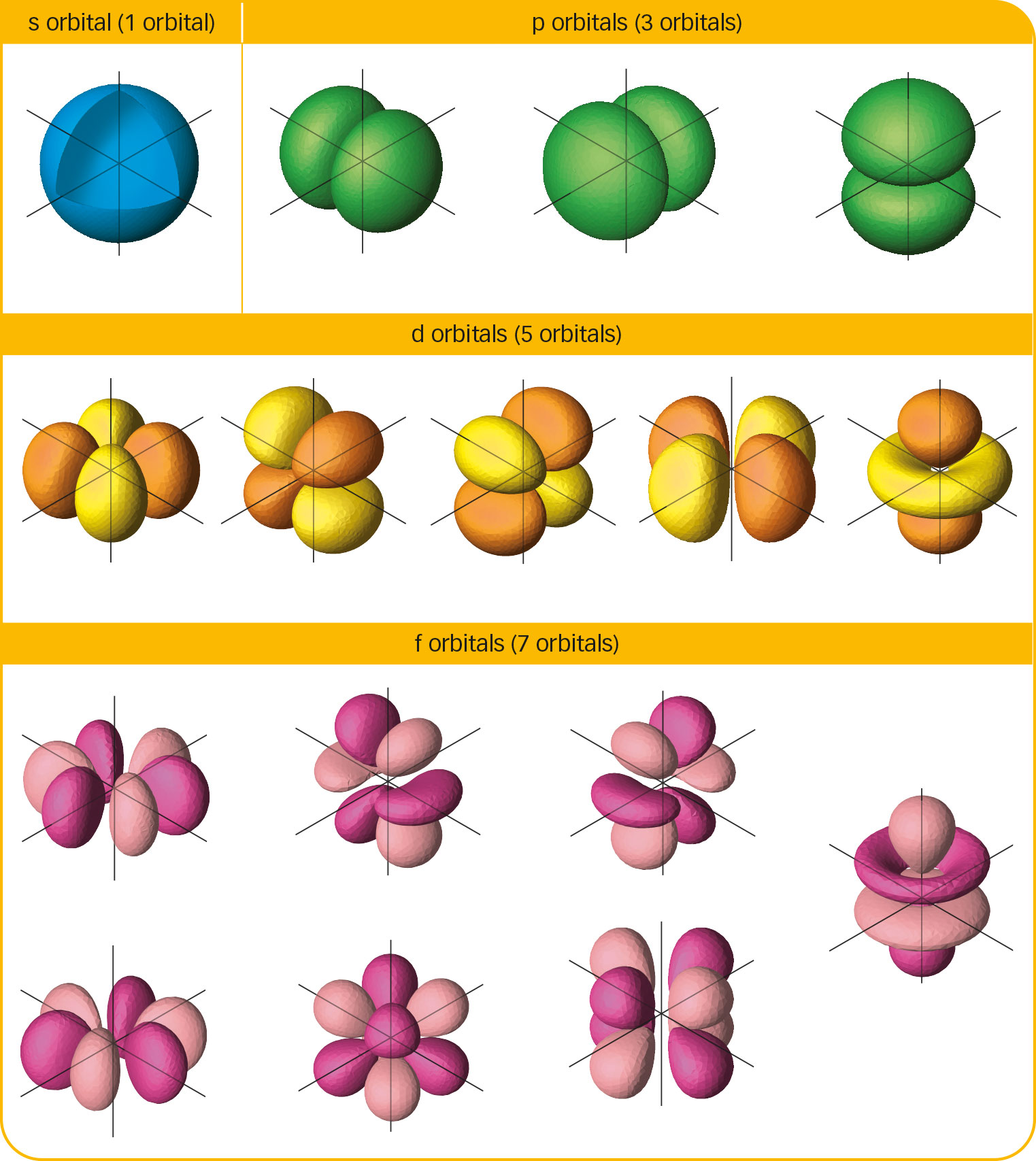

       
      The location of the orbitals
      subtitulo

      Schrödinger's investigations led to the discovery of the orbitals in each layer of the atom's shell:

      • Layer 1: one s orbital.
      • Layer 2: s and p orbitals.
      • Layer 3: s, p and d orbitals.
      • Layer 4 and following layers: s, p, d and f orbitals.
       
      Orbital energy
      subtitulo

      In general, an orbital's energy depends on its layer.

      All orbitals of the same type in the same layer have the same energy, unless the atom is in a magnetic field. Each layer represents an energy level, and each type of orbital is a sub-level.

      The Moeller diagram is a mnemonic tool that indicates the order of the orbitals according to their energy.


       Summary. The modern atomic model

      ,
      You have completed the lesson!

      Below is the time you have spent on the activity and the score you obtained.

      Time spent

      Score

      1. 1
      2. 2
      3. 3
      4. 4
      5. 5
      6. 6
      7. 7
      8. 8
      9. 9
      10. 10
        Eraser
        Rich text editor
        close